This project was part of my undergraduate dissertation where I experimentally tested the widespread belief that ‘TikTok is rotting our brains’. Looking back at it, there’s certainly things I could do better. Still, it holds a special place in my heart, not only for inspiring me into the field of research, but also being the culmination of my years as a psychology student at St. Andrews.
The Experiment
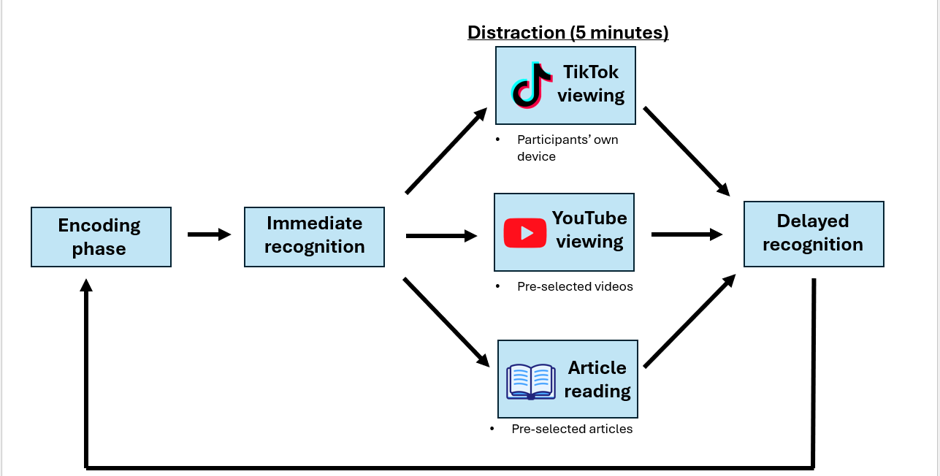
The actual experiment itself was rather straightforward. It consists of a task-distraction paradigm meant to simulate the real life occurrence of social media ‘checking’ behaviour (i.e. being distracted by our phones throughout the day). Essentially, the participant would perform a memory test before and after doing 5-minutes of three activities:

Watching TikTok videos

Watching a single YouTube video

Reading an academic article
The memory test administered is called the Old/New recognition memory test, which gives you a list of 50 words to ‘encode‘ at the start, before tasking you to recognize whether a word was shown before, or a completely new word. To know more, you can visit this website and try out a demo version of this test. Our experiment utilizes a slightly different variant, where the ‘recognition’ part is split into an immediate and delayed phase, where the aforementioned 5-minute distractions are administered in-between.
The Results
I wish there was a clear, surmisable conclusion I can write out here to blow some minds, but unfortunately, the results of this study is filled with too many technicalities and ‘urm, actually…’s to be summarized into a single line. To know the entire journey of how this project went down, I highly recommend reading my full-dissertation below!