What makes a country “popular”?
Contents
1. Global Attention Profile (GAP)
2. Media vs Public Attention
3. Why r/politics?
4. Methodology
5. Results
6. Discussion
7. Conclusion
‘Popular’ in this case does not mean how ‘liked’ a country is, but rather its international visibility. In media studies, a country’s latent international visibility can be quantified through the news coverage it receives.
It is perhaps no surprise to everyone that media coverage towards different countries are not always equal. The USA, for example, is always the topic of discussion over the Republic of Djibouti.
This apparent inequality was captured and studied in depth by Dr. Ethan Zuckerman at Harvard University.
The Global Attention Profile (GAP)
Zuckerman, E. (2003) , Global Attention Profiles – a Working Paper: First Steps Towards a Quantitative Approach to the Study of Media Attention. Berkman Center Research Publication No. 2003-06, Available at SSRN: https://ssrn.com/abstract=487943
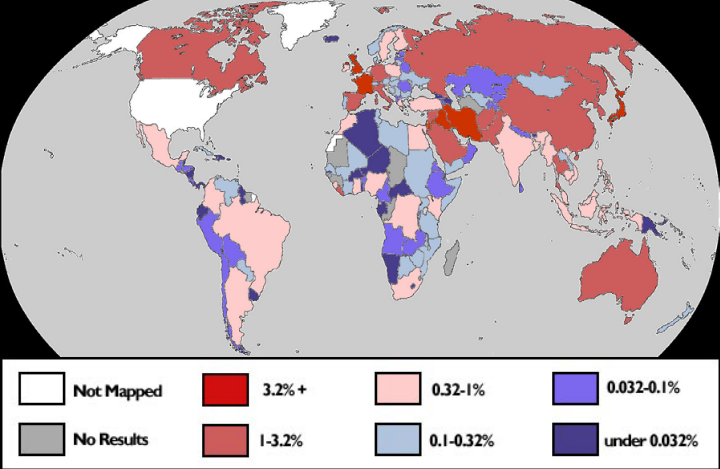
Zuckerman was a pioneer in using large, quantitative data techniques to assess the media attention countries receive. Using Perl, he built various automated scripts (called ‘scrappers’) that searched nine major news websites* for coverage of 183 countries. The scrapers gathered a core information: the total number of stories available for a given country within a time period, a.k.a. the Global Attention Profile. From this, he was able to correlate a country’s number of news stories with different World Bank datasets, like GDP, Population etc.
*All nine major news sites:
Associated Press (AP), AltaVista, BBC, CNN, Google News, the New York Post, the New York Times, Reuters, & the Washington Post.
Zuckerman’s Findings
Across all economic variables, GDP was found to be the strongest predictor of the news coverage amount a country receives. Moreover, GDP’s correlation was even significantly stronger than the correlation between media attention and population size. To put this into perspective, Japan and Nigeria share similar population sizes (127-130 million), yet Japan receives roughly 7 times more coverage by American media than Nigeria, a disparity reflected by their GDP gap of Japan’s $4 trillion compared to Nigeria’s $41 billion.
These results confirmed what is readily observable in every day life: the Global South is frequently overlooked by Western media, and the reason is economic. Bluntly put: ‘poor countries are not relevant enough to be covered’. There is much cause for concern about such inequalities in regional attention, because they could feed into poverty cycles through the agenda-setting phenomenon. If a poor country is deemed irrelevant and not part of the global agenda, its crises go unheard of, no one invests in the country, no governments provide aid, thus it remains poor and irrelevant.
…consciously or not, the people who decide what becomes news are far more likely to cover a story if it involves people from wealthy nations
(Zuckerman, 2004)
Zuckerman, E. (2004). Using the internet to examine patterns of foreign coverage. Nieman reports, 58(3), 51. Available at: https://niemanreports.org/using-the-internet-to-examine-patterns-of-foreign-coverage/
Media attention vs. Public attention
Kwak, H., An, J., Salminen, J., Jung, S. G., & Jansen, B. J. (2018, April). What we read, what we search: Media attention and public attention among 193 countries. In Proceedings of the 2018 world wide web conference (pp. 893-902). https://doi.org/10.1145/3178876.3186137
However, the agenda-setting phenomenon is not the be all and end all. In fact, Kwak and colleague’s study raises the point that when it comes to foreign news, what the media covers is not always what the people care about. By drawing from distinct types of data sources, they were able to distinguish two types of attention towards foreign news across 193 countries:
Media attention
The attention paid to foreign news by media organizations, gathered from Google News data by counting how many news articles from one country mentioned another country (among the top 100 articles).
Public attention
The attention paid to foreign news by the people of a country, gathered from Google Trends search volume data, measuring how much people in one country were actively searching for information about another country.
Kwak and Colleague’s findings:
Using a multiplex network model, they revealed that in 63.2% of countries, media attention was significantly different to public attention. Furthermore, consistent with Zuckerman’s GAP report, media attention tended to be concentrated on a small number of high GDP countries. To exemplify this mismatch, in 27% of countries, the media paid most attention to the US news. Yet, among those 27% of countries, the public’s Google search interests were usually skewed somewhere else, like Germany or Japan.
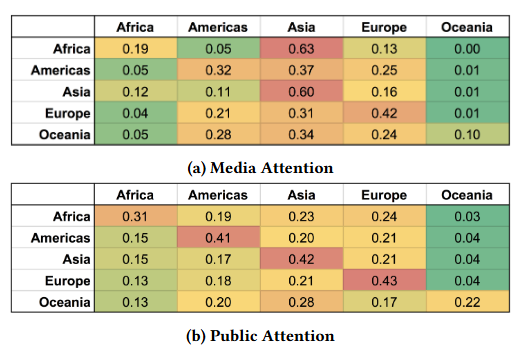
Interestingly, public attention tended to exhibit both global and local characteristics. While public attention was more equally distributed across countries than media attention, larger shares of public attention were still paid to countries in the local region rather than countries further away. For instance, the media in African countries disproportionately focus on news from Asian countries, but public attention showed that Africans care similarly about news from most continents, though they naturally care slightly more about news within Africa.
Attention Flow among Regions
This table shows the proportion of a region’s total attention going to each destination.
Each row represents the source region (i.e. who is paying attention). Each column represents the destination region (i.e. who is receiving attention).
Red indicates a higher proportion of attention. Green indicates a lower proportion of attention.
The case for Reddit and r/politics
Chadwick, A. (2013). The hybrid media system: Politics and power. Oxford university press.
Vo, L. T. (2019). Mining Social Media: Finding Stories in Internet Data. No Starch Press. Available at: https://socialdata.site/
In the digital era, the distinction between ‘Media Attention’ and ‘Public Attention’ are not so clear cut. As Dr. Andrew Chadwick puts it, social media has created a ‘hybrid media system‘, where the ‘agenda‘ is now determined by the interaction between professional news organizations, and spontaneous public interest. Therefore, it is important that research on global media attention inequalities, like Zuckerman’s GAP model, are adapted to social media.
In her book ‘Mining Social Media’, Lam Thuy Vo described how social media data collection can be applied to a range of social studies. Variables such as viewership, engagement, and comments all serve as invaluable, naturally occurring information about a population’s opinions and reactions to any given topic. The platform Reddit, for one, is favoured for its built-in functions that expedite the research process*.

Reddit hosts a massive collection of topic-specific forums (subreddits), this makes it easy to isolate themes for social research, i.e. healthcare, finance etc. Additionally, Reddit’s engagement system consists of clear two-way rating: upvotes signaling positive reception, downvotes signaling negative reception. This makes traditional research methods like sentiment or discourse analysis highly efficient.
*A list of studies utilising Reddit for research.
Stine, Z. K., & Agarwal, N. (2020). Comparative discourse analysis using topic models: Contrasting perspectives on China from reddit. In International Conference on Social Media and Society (pp. 73-84). https://doi.org/10.1145/3400806.3400816
Schrading, N., Alm, C. O., Ptucha, R., & Homan, C. (2015). An analysis of domestic abuse discourse on reddit. In Proceedings of the 2015 conference on empirical methods in natural language processing (pp. 2577-2583).
Guimaraes, A., Balalau, O., Terolli, E., & Weikum, G. (2019). Analyzing the traits and anomalies of political discussions on reddit. In Proceedings of the International AAAI Conference on Web and Social Media (Vol. 13, pp. 205-213). https://doi.org/10.1609/icwsm.v13i01.3222
De Choudhury, M., & De, S. (2014). Mental health discourse on reddit: Self-disclosure, social support, and anonymity. In Proceedings of the international AAAI conference on web and social media (Vol. 8, No. 1, pp. 71-80). https://doi.org/10.1609/icwsm.v8i1.14526
Park, A., Conway, M., & Chen, A. T. (2018). Examining thematic similarity, difference, and membership in three online mental health communities from Reddit: a text mining and visualization approach. Computers in human behavior, 78, 98-112. 10.1016/j.chb.2017.09.001
Why r/politics?
Hofmann, V., Schütze, H., & Pierrehumbert, J. B. (2022). The reddit politosphere: a large-scale text and network resource of online political discourse. In Proceedings of the international AAAI conference on web and social media (Vol. 16, pp. 1259-1267).
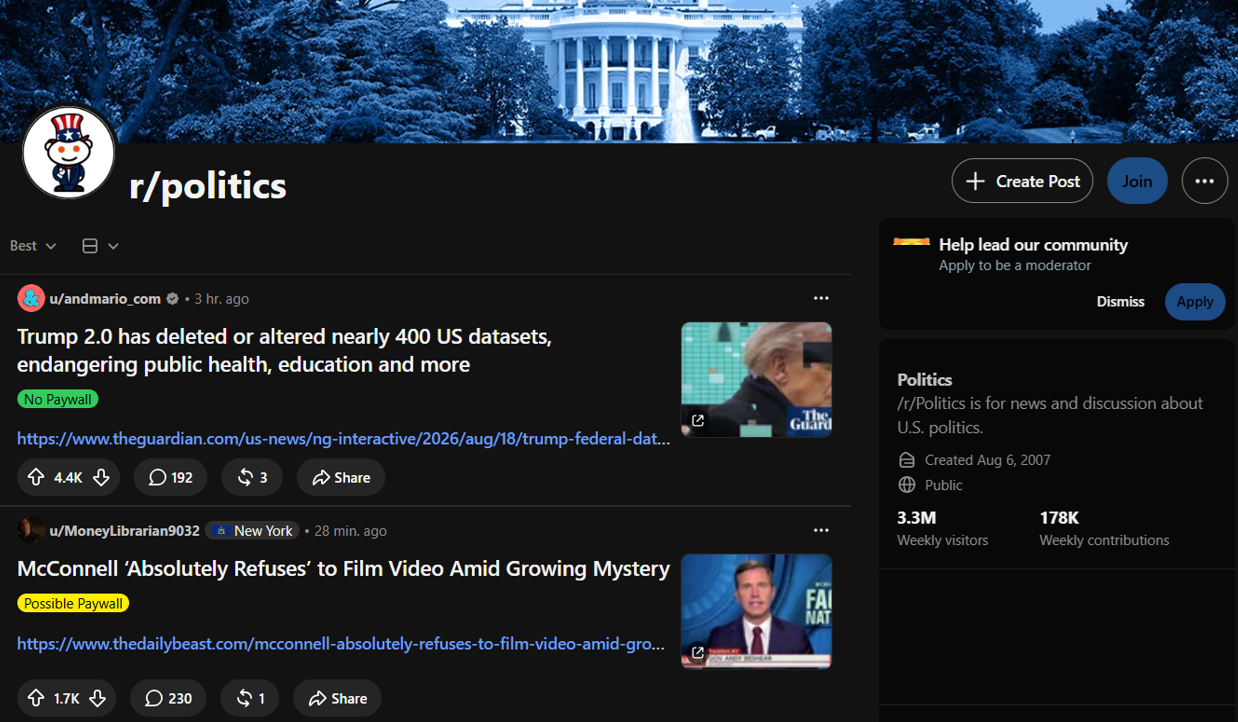
In their study, Hofmann and colleague established the network of politics-centric subreddits for future researchers, named the ‘Reddit politosphere’. Within this network, r/politics is used as the reference point for every other subreddit. First, because r/politics is the largest politics-centric subreddit, consisting of 9.2 million followers, and dedicated to political news-sharing and discussions. Second, due to this large size, it is also the most ideologically diverse and neutral (although Reddit as a whole tended to lean left/liberal).
Moreover, as a news-sharing forum, r/politics acts as an ideal middle ground between Media Attention and Public attention, integrating both official foreign news reported by organizations, and public-driven interests in foreign news reflected by engagement. Notably, given that Reddit is an American dominated platform, and r/politics is primarily focused on US politics, investigating r/politics provides further insight into the ‘popularity’ of countries from the US point of view.
Methodology
My approach leverages Reddit’s search and filter function to investigate the Media/Public attention on 30 countries*, as illustrated by the metric of social media engagement. Additionally, to simulate Zuckerman’s GAP model, a multiple regression analysis was conducted to link the engagement each country receives to its GDP per capita and population information, as gathered through World Bank Group and Macrotrends respectively.
*The selection was diversified across all continents while covering a balanced spread from low to high GDP per capita and population size. The full list of countries include:
Albania, Argentina, Australia, Bangladesh, Botswana, Brazil, China, Costa Rica, Cuba, Egypt, Ethiopia, France, Germany, India, Indonesia, Ireland, Jamaica, Japan, Kyrgyzstan, Lithuania, Malaysia, Mexico, Namibia, Nepal, Nigeria, Pakistan, Russia, Singapore, South Africa, Switzerland, Uruguay.
A step-by-step account of the data collection method:
1.
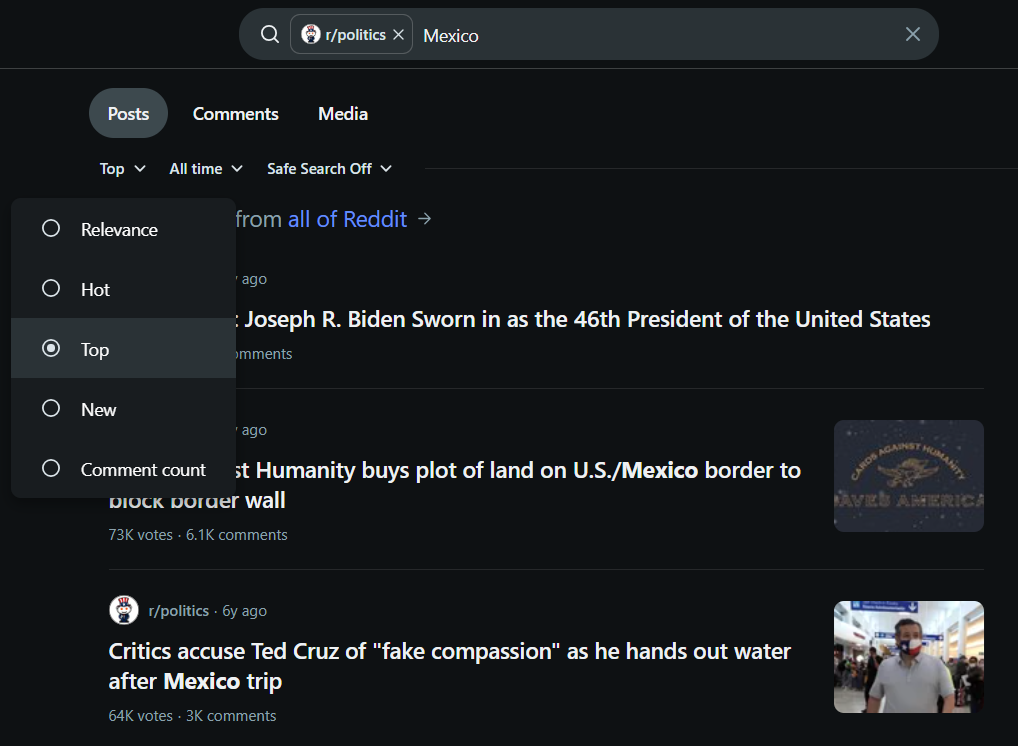
Type in the name of a country into r/politics search bar, and sort posts by ‘Top‘ and ‘All time‘.
This presents us with a list of posts that mentions the name of a specific country, sorted by descending ‘upvotes’ count.
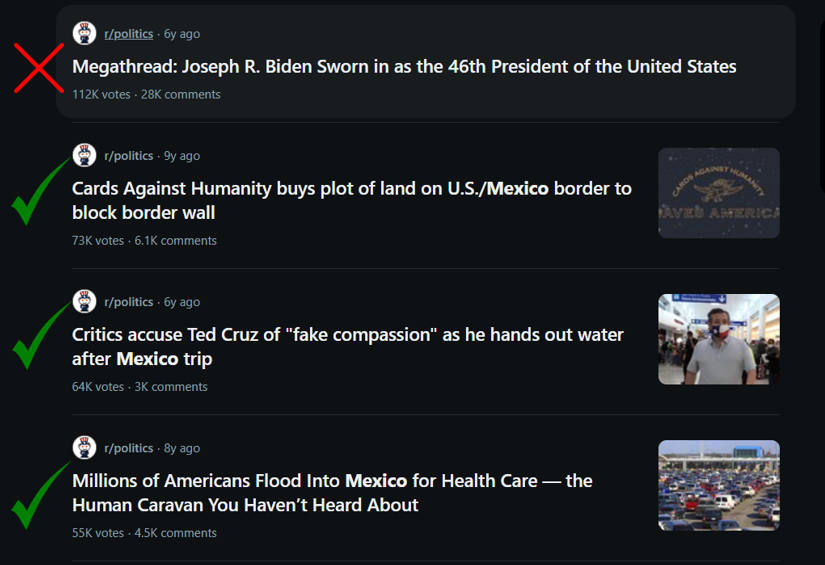
2.
From this list, manually select for the top 10 posts that mention the name of the target country in the post title.
Reddit’s filter function includes the mention of keywords within the comments but not the title, these types of posts are excluded.
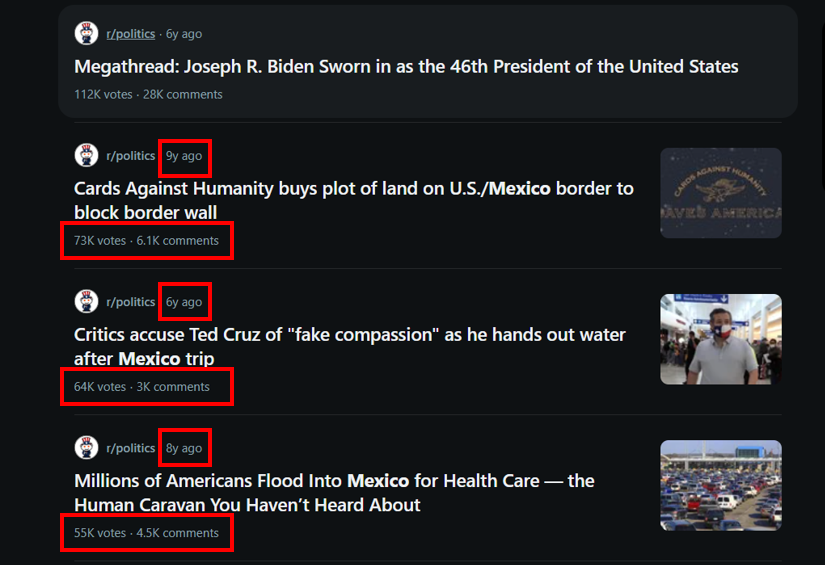
3.
Collect the following three information for the top 10 posts: Upvote count, Comment count, and Year it was posted.
Note: Reddit does not display the exact figures when engagements exceed 1000, in which case they are approximated to 2 significant figures.
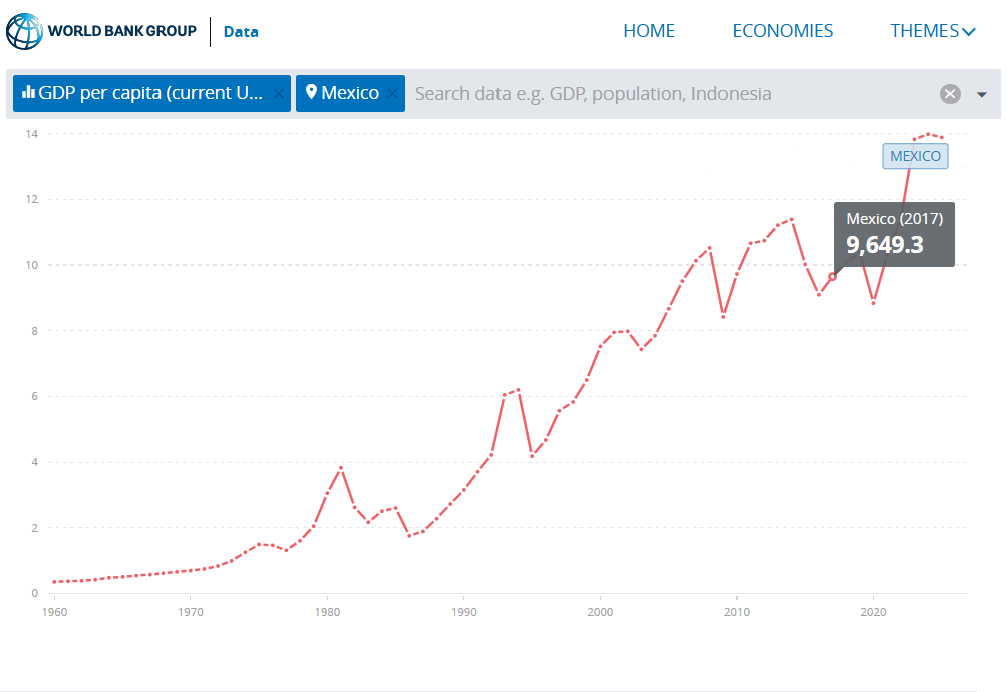
4.
Through World Bank Group and Macrotrends, collect the GDP per capita and Population information that corresponds to the year each of the 10 posts were made.
Each figure was rounded to 1 decimal place.
To clarify, while incorporating automated post ‘scrappers’ for r/political is a feasible method, manual data collection can be beneficial in certain contexts. For instance, countries with names like ‘Georgia‘ will confound results for a scrapper, since it cannot distinguish between ‘Georgia, Atlanta‘ and ‘Georgia the country‘. As such, manual data collection gives researchers the opportunity to verify news content.
Data Analysis
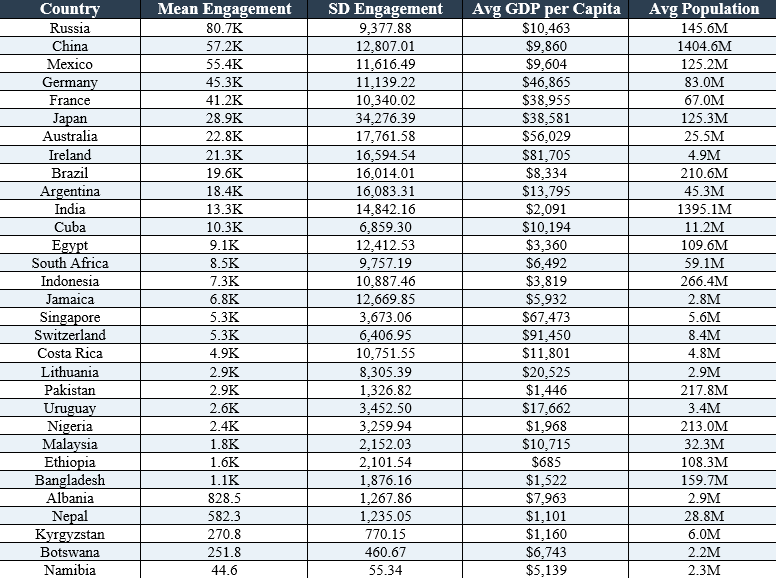
The raw data consists of ‘upvote’/’comments’ values gathered across 300 r/politics posts, which was transferred as a .csv file for analysis on Python. For each individual post, ‘total engagement‘ was calculated by summing up the values of its ‘upvotes’ and ‘comments’ *. Then, for each country, ‘mean engagement‘ was calculated by averaging total engagement over 10 posts. For GDP per capita and population, the averages across the years relevant to the top 10 posts were used for analysis.
*
Interestingly, there is a debate that social media ‘likes’ are not equivalent to ‘comments’ as a representation of engagement, since comments often take more effort. This discrepancy can easily be accounted for by applying a multiplier effect to the number of comments, though there is no consensus on what such a multiplier should be.
Chugh, R., Patel, S. B., Patel, N., & Ruhi, U. (2019). Likes, comments and shares on social media: Exploring user engagement with a state tourism Facebook page. International Journal of Web Based Communities, 15(2), 104-122. https://doi.org/10.1504/IJWBC.2019.101041
Yoon, G., Li, C., Ji, Y., North, M., Hong, C., & Liu, J. (2018). Attracting comments: Digital engagement metrics on Facebook and financial performance. Journal of Advertising, 47(1), 24-37. https://doi.org/10.1080/00913367.2017.1405753
Regression Analysis
A multiple linear regression model was used to investigate the predictive relationship between a country’s GDP per capita and population with their engagement on r/politics. The standard assumption checks for linearity, homoscedasticity and residuals normality using residual vs fitted, QQ plots, Shapiro-Wilks test, and VIF test were conducted. While VIF test detected no multicollinearity between GDP per capita and population, every other assumption checks were violated. This was unsurprising, since mean engagement was heavily skewed between certain countries. To address this, I use the established method in social media studies of applying logarithmic transformations to the ‘engagement’ variable*, after which assumptions were met.
*
Bhattacharya, S., Srinivasan, P., & Polgreen, P. (2017). Social media engagement analysis of US Federal health agencies on Facebook. BMC medical informatics and decision making, 17(1), 49. https://doi.org/10.1186/s12911-017-0447-z
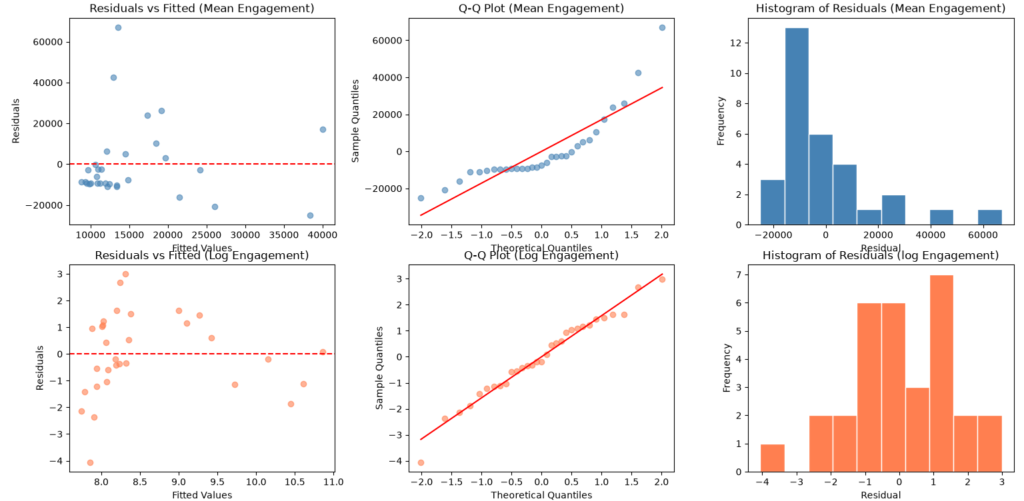
The regression model revealed significant effects (F(2, 28) = 4.827, p = .0158), explaining 20.3% of the variance in log-engagement (R2 = .256, Adjusted R2 = .203). The results indicate that nations with higher wealth and population tend to receive increased engagement from r/politics users. Both GDP per capita and population were found to be a significant positive predictor of log-engagement (β = 2.99 × 10² , t (28) = 2.494, p = .019), and (β = 2.04 × 10⁻⁹ , t (28) = 2.338, p = .027) respectively. The unstandardized regression equation was as follows:
Log Engagement = 7.696 + (2.99 × 10⁻⁵)(GDP per capita) + (2.04 × 10⁻⁹)(Population)
The GAP model lives on?
On the whole, the results seemed to have replicated Zuckerman’s original findings down to the details. The amount of attention a country receives is dictated by its wealth and size. Additionally, much like how GDP was found to be the most dominant factor in determining attention, my analysis showed GDP per capita’s predictive effect to be more powerful than population’s. However, my findings do offer a few extra insight into global media attention inequalities.
GDP per capita vs GDP
Pure GDP is widely considered an unreliable measure for a country’s economic success and development. In fact, since it measures total national output, GDP tends to correlate strongly with population anyway. By focusing on GDP per capita instead, a clear distinction is set between wealth and population’s effect on international visibility. The story is twofold: countries with wealthy citizens AND countries with many citizens are paid attention to. Subsequently, the explanations for both scenario can be equally distinct.
For example, it would make sense for population, by itself, to influence a country’s engagement. News in populated places impact more people, and by virtue are covered. A UCL study discovered that news coverage for national events scales linearly with a region’s population, and this happens even within borders. For example, during the 2017 earthquake in Mexico, Mexico City received about 2.5 times more media coverage per 100,000 inhabitants than Puebla or Toluca, explainable by its ten times larger population than the latter two cities*.
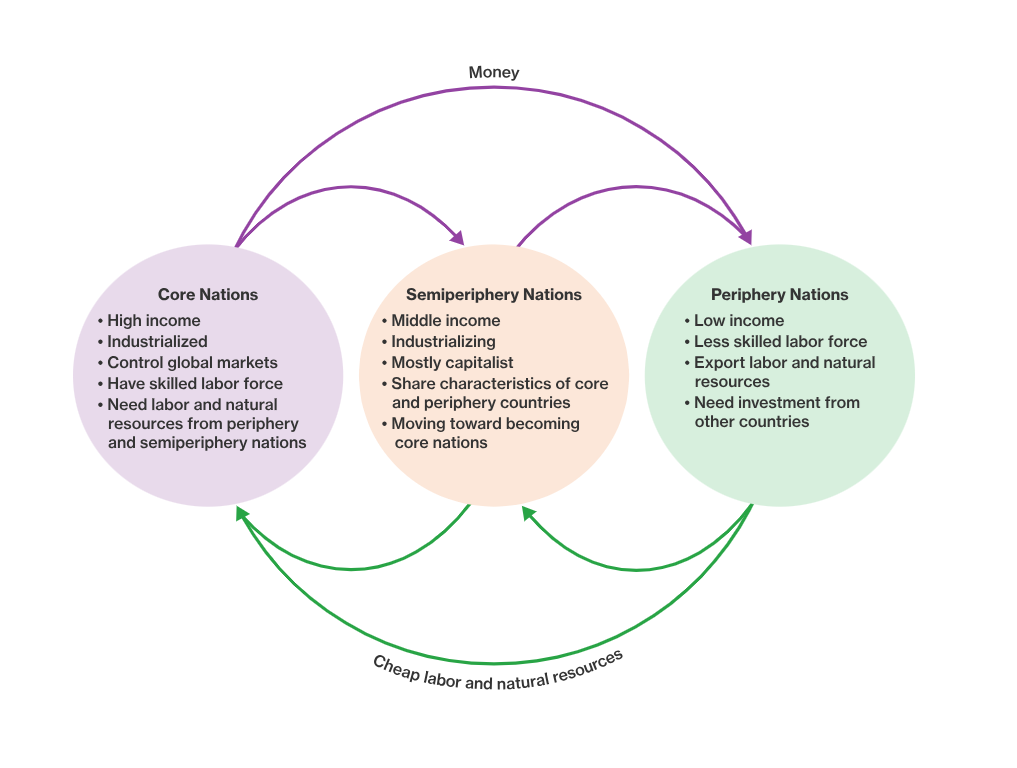
On the other hand, high national incomes, living standards, and developed infrastructure are all factors that drive a country’s tourism, skill market and financial relevance*, textbook components of the ‘Core Nations‘ that command the global network within Wallerstein’s World Systems theory. To put it anecdotally, the average r/politics user (American) will have more stake in countries they are vacationing, working, or investing in. As such, the influence GDP per capita has over engagement may simply be a reflection of this fact.
*
Curiel, R. P., Arnau, C. C., Pinedo, M. T., Ramírez, H. G., & Bishop, S. R. (2019). Temporal and spatial analysis of the media spotlight. Computers, Environment and Urban Systems, 75, 254-263. 10.1016/j.compenvurbsys.2019.02.004
Chen, Q. (2023). The impact of economic and environmental factors and tourism policies on the sustainability of tourism growth in China: evidence using novel NARDL model. Environmental Science and Pollution Research, 30(7), 19326-19341. 10.1007/s11356-022-22925-w
Convergence of Media and Public Attention
Going back to Kwak and colleague’s report, they reason that it is only natural for there to be instances when both media attention and public attention towards foreign news can align. For instance, a major political incident like Brexit can simultaneously attract media AND public interest for the UK, thereby increasing BOTH official news count and Google searches for UK. In this regard, online political forums act as an ideal environment to facilitate such attention alignments.
Online communities often act as an outlet in response to major global events. In times of crises like natural disasters or international conflict, social media becomes a platform for information-sharing, emotional expression, political activism and sense-making*. In that case, the majority of r/politics posts likely represent reactions TO global news, rather than spontaneous, public-driven curiosity to news.
By all means, online communities do not always readily align with media narratives, and it is possible that wealth and population biases to foreign news exists for public attention per se. However, the tendency for online communities to converge media and public attention simply offers another explanation as to why r/politics users display biases similar to the media, as established by Zuckerman’s GAP model.
*
Maldeniya, D., De Choudhury, M., Garcia, D., & Romero, D. M. (2023). Pulling through together: social media response trajectories in disaster-stricken communities. Journal of Computational Social Science, 6(2), 655-706. https://doi.org/10.1007/s42001-023-00209-8
Park, S., Atkinson, S., Fulton, J., Wong-Parodi, G., & Mani, L. (2024). Communicating in crisis: Community practices of online participation during extreme events. Climate Disaster Preparedness: Reimagining Extreme Events through Art and Technology, Cham: Springer, 199-211. https://doi.org/10.1007/978-3-031-56114-6_15
Conclusion
With how expansive the online world is, it is hard to get the ‘full picture’ of media attention, let alone capture human behaviour surrounding it. As Zuckerman acknowledges: “GAP strives to be comparatively accurate, not absolutely accurate.” The goal of this project was never to fully analyze media consumption biases in its entirety, but to demonstrate the empirical means to identify meaningful patterns. What this project offers is a novel outlook on how global inequalities in country visibility manifest in online spaces. Despite the change in media delivery and consumption culture today, biases to foreign news attention are still present. Certain countries remain bathing in the spotlight, while certain countries’ cries remain ignored…
Behind The Scenes

<— To access the raw data, .csv file, and python script, visit my GitHub repository.
My initial wish was to include as many countries as I can, alas the time and effort requirements got the best of me… If you’re curious what your own country’s engagement on r/politics are, feel free to build upon the data with more samples using my methodology! Email me when you do 😉